Guest viewing is limited

Meatpie's Atlas of Forensic Medicine

During the investigation of a deceased 24-year-old male, who was found in his room, it was determined that the victim had been asphyxiated by helium gas. The examination of the body revealed intentional staging: a black polyethylene bag secured tightly around the neck with gray adhesive film, a white-transparent tube which connected to a helium gas cylinder was placed inside the bag. The victim was found reclining on a bed.

Although a chest scar was noted during external inspection, no other signs of trauma were found. However, internal examination revealed nonspecific signs of asphyxiation, including petechial hemorrhages in the conjunctiva of the eyes and on the surfaces of the heart and lungs. Additionally, the presence of unclotted blood within chambers of the heart, venous congestion of internal organs, and cerebral and pulmonary edema emphasized the severity of the asphyxiation.

Toxicological analysis of the deceased’s blood detected concentrations of quetiapine (0.020 mg/l), citalopram (0.021 mg/l), and bromazepam (0.092 mg/l), suggesting prior ingestion of these substances. Furthermore, metabolites such as alpha-hydroxyalprazolam and 3-hydroxybromazepam were discovered in the urine, along with trace amounts of bromazepam, quetiapine, citalopram, and mirtazapine. No ethyl alcohol was found in both blood and urine samples.

Based on all of the findings during the investigation of a deceased 24-year-old man, including the absence of ethyl alcohol in both blood and urine samples, the circumstances surrounding the victim’s death, the presence of petechial hemorrhages on vital organs, internal organ congestion, and cerebral and pulmonary edema, it was concluded that the cause of death was confined space asphyxiation.

 
The examination of the deceased, a 27-year-old man, provided crucial insights into the circumstances of his death. The individual was discovered in his living room, lying face down on the floor, with no signs of visible physical harm. A blue plastic bag covered victim’s head and was tightly sealed with an adhesive tape. In the bag a burst golden balloon was detected.

However, upon the further examination, during the detailed external inspection three separate wounds were detected. All three wounds, each measuring exactly 0.5 cm in diameter, with irregular edges and surrounded by a reddish-purple bruise approximately 1 cm in diameter were located on the deseased’s nose. During the internal autopsy, although the structures of the throat and neck bones were intact, noticeable petechial hemorrhages were observed on the conjunctiva, epiglottis, and surfaces of the heart and lungs. Additionally, dark, unclotted blood was found in the heart chambers, and significant swelling was observed in the brain and lungs.

Subsequent toxicological analysis revealed ethyl alcohol concentrations of 1.51‰ (per mille) in the blood and 2.36‰ (per mille) in the urine, offering insights into the deceased’s condition before death. Ultimately, the combination of external and internal findings, along with toxicological results, indicated the suffocation in a confined space as the cause of death. All of these evidences shed light on tragic circumstances surrounding the victim’s death, providing a clarity to the investigation.

 
Upon conducting a thorough examination of a deceased male, aged 25, who was discovered in a basement, several significant observations emerged. The body was found in a supine position. Notably, a transparent plastic bag with a tube in it and connected to a gas cylinder, was detected on the head of the deceased.

External inspection revealed nonspecific findings. Victim’s skin presented a pale yellowish color, with purple livor mortis on the dorsal surfaces. Rigor mortis was notably pronounced across all muscle groups. No external injuries were detected on victim’s body. Subsequent internal examination supported the suspicion of asphyxiation. The lungs and brain showed signs of edema, alongside venous congestion of internal organs. Further investigation revealed no evidence of trauma or pathological anomalies within the cranial or thoracic cavities. Toxicological analysis showed negative results for ethyl alcohol, medications and illegal substances in both blood and urine samples.

Summarizing autopsy findings and the circumstances of victim’s discovery, the cause of death was determined as suffocation within an enclosed environment.

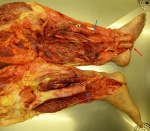
 
Upon conducting a thorough examination of a deceased male, aged 25, who was discovered in a basement, several significant observations emerged. The body was found in a supine position. Notably, a transparent plastic bag with a tube in it and connected to a gas cylinder, was detected on the head of the deceased.

External inspection revealed nonspecific findings. Victim’s skin presented a pale yellowish color, with purple livor mortis on the dorsal surfaces. Rigor mortis was notably pronounced across all muscle groups. No external injuries were detected on victim’s body. Subsequent internal examination supported the suspicion of asphyxiation. The lungs and brain showed signs of edema, alongside venous congestion of internal organs. Further investigation revealed no evidence of trauma or pathological anomalies within the cranial or thoracic cavities. Toxicological analysis showed negative results for ethyl alcohol, medications and illegal substances in both blood and urine samples.

Summarizing autopsy findings and the circumstances of victim’s discovery, the cause of death was determined as suffocation within an enclosed environment.

Now he is my type of man dead or alive.
 
Suicide jump in a shopping mall. Man, 58 years. The victim was 174 cm tall and weighed 88 kg.


A unique case of a death of a 20-year-old college student due to positional asphyxia related to an underlying seizure disorder. The student was found dead in his dorm room. He was positioned with his legs/pelvic on the bed, but his trunk, arms, head and neck hanging downward off the bed, with his face on the floor. His neck was markedly kinked.

Toxicology: No illegal drugs or alcohol were detected. The anti‑epileptic drug oxcarbazepine was present in his urine and blood—blood level at 6.9 µg/mL.

Autopsy: No true anatomical cause of death found. Because of the posture and underlying seizure disorder, death was attributed to positional asphyxia from the seizure disorder.
 
Well he is the perfect position to take the blanket off and clothing and play with.
 
Would you try and taste his feet? Where would you start from?
 
Would you try and taste his feet? Where would you start from?
MP we all have our kinks and feet ain't mine, it maybe yours but not mine. His ass, balls, and dick is where I will start at.
 
Feet are awesome and so very sexy and beautiful.
 
Feet are awesome and so very sexy and beautiful.
For you maybe, for me they are bacteria collectors stuff in a shoe and smell. So no. I like the other body parts.
 
For you maybe, for me they are bacteria collectors stuff in a shoe and smell. So no. I like the other body parts.
A sniff of coke, and I'll suck your feet for hours, Huffko. :rude_footfetish: :yummy:
 
To you. On you. For you.
 
You wish. I’ll have your guts for dinner.
 
We present two forensic autopsy cases of extension-type vertebral fractures occurring in flat-surface settings. The first case involved a man in his 50s who sustained a thoracic vertebral fracture and cardiac rupture after being compressed dorsally in the prone position by a 1,000-kg brush cutter. The second case involved a man in his 90s with kyphosis who sustained a lumbar extension-type fracture during cardiopulmonary resuscitation after collapsing outdoors. These cases highlight the importance of considering posture and biomechanical forces in the forensic evaluation of spinal fractures.

 
Autopsy on a tortured young man from Ukraine.

 
Back
Top
